Category Archives: social media strategy

Beyond The Tweet: What’s The “Best Practice” for Tweet Frequency and Timing?

As a prolific tweeter, one of the questions I’m often asking myself is, “How often should I be tweeting?” And although I continue to tweet from multiple accounts both professionally and personally, I haven’t come to a perfect conclusion as yet. Is the right answer once a day? Once an hour, on the hour? Multiple times an hour? And what about retweets and modified retweets- how do they fit into that mix? And replies? Is there a standard best practice for tweet frequency, a “sweet spot” for Twitter success?

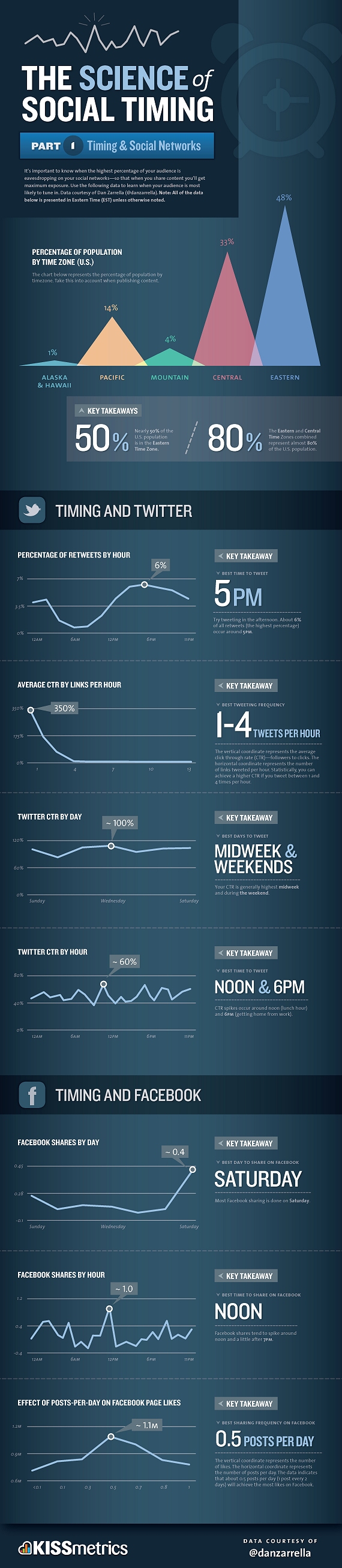
According to KISSmetrics‘ data below (a handy little infographic I found on Pinterest that covers Twitter and Facebook frequency and timing), Twitter users who tweet between 1 and 4 times per hour are more likely to get click throughs to their tweeted content. While that guideline may be sound, I’d caution against taking it as an absolute “best practice” (not ever tweet is effective even if you’re abiding by the recommended frequency). In looking at when to tweet, KISSmetrics recommends mid-week and weekends either at noon or 6 p.m. as the best days and times (again based on click through rates). For amplification, Kissmetric recommends tweeting around 5 pm when the likelihood of retweets is highest.

Ultimately, whether tweeting for personal or professional use, your tweets will arguably be their most effective not based upon frequency but upon value to your followers. Rather than ask how frequently you should be tweeting at your followers, ask what kinds of information you’re sharing with and engaging with them around- either by tweeting, replying, or retweeting others’ content.

With any form of writing, the best and most effective pieces of communication are crafted with a clear and true understanding of the intended audience. Why should Twitter be treated any different? While a single tweet may only be 140 characters, it is still a form of writing and the maxim for “knowing your audience” is just as applicable. Knowing what kind of content is valuable to your audience is not only necessary for your desired impact, but I would argue is also the key to understanding how frequently your audience wants to hear from you. Moreover, it’s understanding when they want to hear from you.

If your social media strategy is to send out tweets that could have been written by a robot and link to a press release, you might want to rethink your strategy. If you’re tweeting at your followers far more than you are replying or even retweeting, then you might want to review your engagement priorities. And if you view the number of Twitter followers as indicative of your success on the platform, you might want to revisit your key performance indicators. In fact, you might even want to ask if Twitter is for you.

Agree? Disagree? Tweet with me: @NicKnowsMKTG.
4 Strategies for “Unfriending” Social Media Fatigue

It’s inevitable. Between tweeting and liking, pining and sharing, checking-in and Google “plusing” …there are a lot of places to be, be seen and be heard across social media. And, if you’re on Twitter, Facebook, Linked In, Foursquare, Google+, Pinterest and blogging to boot; keeping up “appearances” can become quite a challenge! It’s the modern-day version of an oft heard complaint: Doesn’t anybody stay home anymore?

When it comes to social media, nobody is “staying home” these days. Instead, we’re busy trying to be everywhere all at once. From my own experiences* in managing personal and professional social media pages and profiles, it’s an uphill climb from which fatigue can quickly set in. So, when social media fatigue comes calling, what does a social media manager do?

1) Retrench

Think about your social media strategy and reevaluate its “successes.” Gain a better understanding of how a social media platform can work for you or for your company. Just because Pinterest is now the third largest social network, it’s important to ask if it’s the right forum for you, your brand or your content. Is your strategy to canvass every platform? Does it make sense to do so? Do you have the manpower and resources to properly manage and maintain a presence on multiple platforms? Or are you spreading yourself or your company too thin- thereby losing the opportunities for success that social media would otherwise present to you? Knowing what “success” in social media means to you or your company will help you evaluate where you ought to be…not every social network does the same thing for the same audiences.

2) Revisit Content Development

A great resource for building content is often right under your nose. Participating in discussions on other blogs and forums can be an invaluable way to better understand what is top of mind for your target audience. Whether you’re gauging interest for a Twitter campaign or checking out what content people are recommending on Google+, it’s essential not to work in a vacuum. Spend more time listening and responding online rather than sitting in front of a solitary keyboard or in a conference room trying to generate compelling content.

3) Take a Social Media Sabbatical

The prospect of stepping away from your social media accounts for a week or even simply a day can be a truly frightening one. You worry about what you’ll miss or that you’ll promptly be forgotten and left behind. But sometimes, a sabbatical from social media is just the vacation you need to return refreshed and excited to pounce on new ideas with the enthusiasm and levelheadedness that successful management of social media engagement requires. Of course, not everyone or every social media team has the ability or capacity to completely “unplug,” and I’d be remiss if I didn’t caution against taking a sabbatical without first ensuring someone else is “minding the store.” If you’re worrying about what is happening in your absence, then the sabbatical and its merits will evade you.

4) Put Your Communities to Work For You

You’ve taken the time to build multiple social media communities, so why not- when appropriate- reach out to them and ask for assistance? The fact is, every one of us has been there and dealt with social media fatigue in our own way. So, while you can read what others have done just as you’re reading this post from me now, sometimes it’s better and far more valuable to engage with your own community and benefit from the interactions that can result. In short, while there are resources available, the best resource is in your own social network.

What resources or strategies for combating social media fatigue have you found and applied with success?

*The irony of this blog post, of course, cannot be lost upon me…I launched Social Outlier amidst a bout of my own social media fatigue and neglected to write for nearly two weeks. During that span of time, however, I was personally able to identify these strategies for combating social media fatigue and recommend them to you!