Category Archives: best practices

Beyond The Tweet: What’s The “Best Practice” for Tweet Frequency and Timing?

As a prolific tweeter, one of the questions I’m often asking myself is, “How often should I be tweeting?” And although I continue to tweet from multiple accounts both professionally and personally, I haven’t come to a perfect conclusion as yet. Is the right answer once a day? Once an hour, on the hour? Multiple times an hour? And what about retweets and modified retweets- how do they fit into that mix? And replies? Is there a standard best practice for tweet frequency, a “sweet spot” for Twitter success?

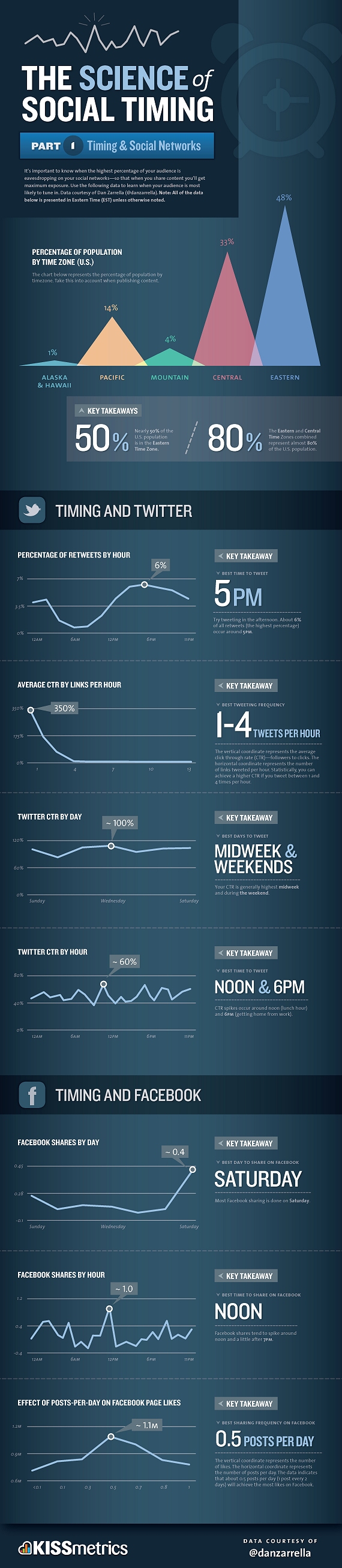
According to KISSmetrics‘ data below (a handy little infographic I found on Pinterest that covers Twitter and Facebook frequency and timing), Twitter users who tweet between 1 and 4 times per hour are more likely to get click throughs to their tweeted content. While that guideline may be sound, I’d caution against taking it as an absolute “best practice” (not ever tweet is effective even if you’re abiding by the recommended frequency). In looking at when to tweet, KISSmetrics recommends mid-week and weekends either at noon or 6 p.m. as the best days and times (again based on click through rates). For amplification, Kissmetric recommends tweeting around 5 pm when the likelihood of retweets is highest.

Ultimately, whether tweeting for personal or professional use, your tweets will arguably be their most effective not based upon frequency but upon value to your followers. Rather than ask how frequently you should be tweeting at your followers, ask what kinds of information you’re sharing with and engaging with them around- either by tweeting, replying, or retweeting others’ content.

With any form of writing, the best and most effective pieces of communication are crafted with a clear and true understanding of the intended audience. Why should Twitter be treated any different? While a single tweet may only be 140 characters, it is still a form of writing and the maxim for “knowing your audience” is just as applicable. Knowing what kind of content is valuable to your audience is not only necessary for your desired impact, but I would argue is also the key to understanding how frequently your audience wants to hear from you. Moreover, it’s understanding when they want to hear from you.

If your social media strategy is to send out tweets that could have been written by a robot and link to a press release, you might want to rethink your strategy. If you’re tweeting at your followers far more than you are replying or even retweeting, then you might want to review your engagement priorities. And if you view the number of Twitter followers as indicative of your success on the platform, you might want to revisit your key performance indicators. In fact, you might even want to ask if Twitter is for you.

Agree? Disagree? Tweet with me: @NicKnowsMKTG.
QR You Kidding?

QR codes have become ubiquitous, invading all forms of media over the last year. If you keep an eye out for them, you’re apt to notice they’re popping up in some pretty unexpected and entirely questionable places too! As someone who has never really responded to QR codes (except that time I used one as my boarding pass for an American Airlines flight), I figured it was about time I learned what all the fuss is about.

In practice, a QR code allows a complex amount of data to be scanned very quickly. In theory, it enables a greater conversion rate whether that is generating new leads or new sales. (Incidentally, did you know that they were originally created by Toyota subsidiary, Denso Wave, to track vehicles in the manufacturing process?)

With this “newish” capability in hand, advertisers and marketers have slapped QR codes on pretty much anything…anything at all, really…in hopes of generating interest and a qualified response. It reminds me a bit of that old cliché involving the spaghetti thrown at the wall. You know the one (there’s probably even a QR code for it).

That said, there have been some QR code “successes.” Utilizing a QR code at a conference or expo booth, placing one on your business card, and of course including one on a print ad, brochure, or direct mail piece. Not incredibly innovative, but inherently useful. Bear in mind that the content you’re directing someone to could display a web site, but it could also display product reviews, play a video, provide map directions, even perform a Facebook “Like” or Foursquare “Check in.” In other words, think outside of your home page.

But, more often than not, a QR code appears in a place one would be least likely to- and in some cases physically and/or technologically incapable of- scanning it as intended. In fact, there’s the web site WTF QR Codes dedicated to such debacles, including this particular gem:

QR code fail, courtesy of WTF QR Codes

In this case, the QR code is unscannable and life-threatening. Often, beyond the unscanability of a QR code, there’s also a disconnect between the company’s “message” and the code itself. Why should I scan?  Moreover, WHAT am I scanning? What am I certain to find when I get there?

QR code fail, courtesy of WTF QR Codes

The problem with QR codes is less that they are unable to live up to expectations, but that they’re often utilized inappropriately and aren’t “valuable” to those for whom they’re targeted. While it may be easier to scan a QR code rather than physically type in a URL, if the result is unclear or of little merit to the scanner, what’s the point?

Beyond ease of use, what is the incentive for someone to scan your code? And importantly, how are you identifying the value locked behind a jumbled matrix of seemingly meaningless symbols to incentivize the scan of your QR code by your target audience?

In all, QR codes are quickly becoming the modern day “micro-site” of marketing. A flash in the pan. Intended for lead generation and sales. But, utterly disappointing in both their inherent value to consumers and their ROI to the marketers who thoughtlessly employ them.

A Facebook Cover Photo Is Worth A 1000 “Likes”

I’ll be honest. When I first encountered the new Facebook Timeline layout, I hated it. I was never a MySpace user, so I wasn’t one of those who decried their apparent similarities. I simply didn’t see much improvement with the new design beyond bigger graphics and a more scrolling layout. One of which, the cover photo, is the focus of this post.

With Facebook’s rules and regulations regarding a page’s cover photo usage, it begs the question: how is the cover photo different from your standard run-of-the-mill web banner? In fact, how is it better? Answer: it isn’t, unless you know how to use the opportunity given.

The beauty of brands on Facebook is that you have a unique opportunity to interact directly with an audience and get real-time interaction and feedback. You can engage with them. Build brand awareness. Deliver customer service. Generate new business opportunities. Foster thought leadership. These and several other iterations of the same well-worn concepts on using Facebook for business. So what does the cover photo have to do with any of that?

Facebook and Facebook marketers would have you believe that your cover photo is now the “end-all-be-all” of your Facebook Timeline. Read through any number of articles regarding the change to Timeline or attend a webinar on Timeline best practices and you’re bound to be smacked over the head with a top-of-the-list reminder that your cover photo is IMPORTANT. And it is. But, it’s still a photo and the real best practice is to think about how the cover photo can be used to differentiate your brand in an innovative way on a social platform.

Slapping a photo of your company headquarters or some variation of your logo sized for the space allotment is one fill-in-the-blank approach, but it isn’t a very interesting one. And importantly, nothing about that photo selection references that this is your Facebook page and not just another corporate website. What about it is social after all?

Since all company pages just converted to Facebook Timeline last Friday, we’re still seeing how they’re adapting. We’re still looking for innovative uses. I’d recommend looking at VH1’s Facebook page where they’ve played on the “milestone” and “Timeline” piece of the new layout in their cover photo by displaying musical highlights throughout the years. I’d also recommend checking out the Verizon Wireless Facebook page where they’ve integrated fans’ photos taken with Verizon phones. Or, if you’re working in the B2B space like me, take a closer look at what SAP implied in their wordless and otherwise very simple cover photo. And finally, I had to include one particularly spot-on example from Brunner Ad Agency. Nicely done all.

Taking these examples into account, the one piece of advice I’d impart on those thinking about their own Facebook cover photos is to remember that Facebook is first and foremost about people. And people, it’s been said countless times, engage with other people, not faceless companies or brands.

Don’t be afraid to break away from your stock photography and do something creative and personable! Make your cover photo about your company or brand delivering on its promise to your target audience. Remind them why they care. Remind them- in that three-second span of time that it takes them to visit your Facebook page and see your new cover photo- why they should “like” you.

It’s ALIVE!!!

With any blog launch, there’s always the nagging question: “What now?

You’ve picked the blog name, the URL, even the design, but what will the content be? How will it be different? What voice will the blog take on? And…and…and…what now?

So too are the questions circling in my mind as I type this post. As I launch this blog. As I attach my name to its pages.

I’ve been an active personal blogger for six years, but have always done so anonymously. Pseudo-anonymously. As my readership has grown, so too have the number of people I’ve met in person through blogging. I’ve enjoyed and learned from the experiences I’ve had, but I need a professional outlet devoted purely to social media topics.

So, while this initial post is a placeholder of sorts, it sets the stage for what will come. The discussions, learning opportunities, resources, examples, and experiences I encounter along the way as a B2B content and social media marketing manager. Won’t you join me?

If anything, a blog is a living, breathing thing, so…let’s give this blog some life!

What topics are you interested in learning more about in social media? What challenges are you facing? Any tips or recommendations you’d share?